


How Tokyo Ramen Shops Get Ranked: Tabelog, Michelin, TRY & More
How Tokyo Ramen Shops Get Ranked
If you've been researching where to eat ramen in Tokyo, you've probably seen the same names pop up again and again: Tabelog, Michelin, and TRY, plus a couple of ramen-only resources I swear by. Together they shape how Tokyo ramen shops are ranked, and I lean on all of them in my own shop write-ups.

The catch is that none of them work quite the way you'd expect, and Tabelog in particular will steer you wrong if you read it like Google reviews. Below, I'll break down what each one actually means and how I use them together to decide where to eat.
Tabelog's scale isn't what you think it is
Tabelog uses a 5-point scale like Google or Yelp, but forget everything those sites taught you. Its reviewers are mostly Japanese diners who eat out constantly and grade hard, so almost every restaurant lands somewhere between 3.0 and 4.0. A 3.0 means "solid, nothing wrong here," and a good neighborhood shop usually hovers around 3.3 or 3.4.
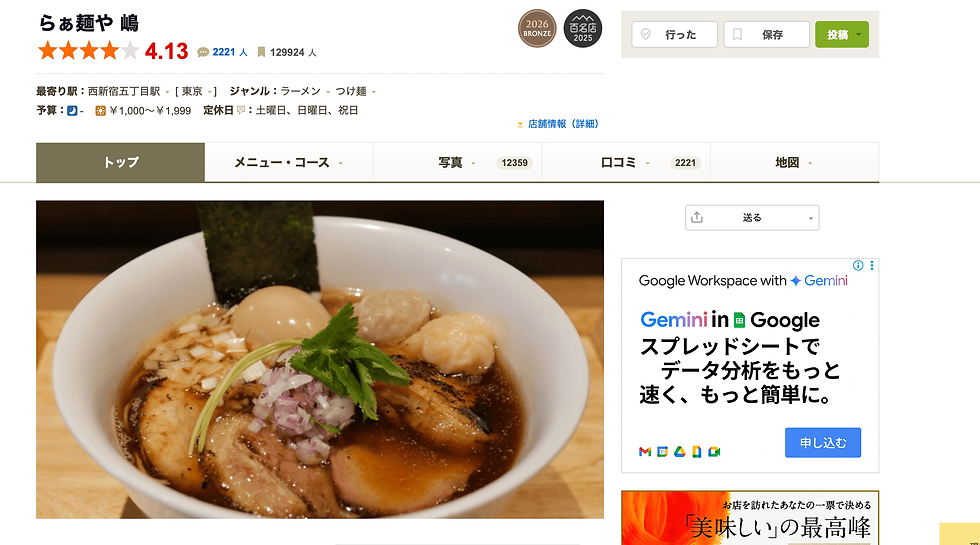
The number to watch is 3.5. Only around 3% of restaurants ever clear it, and for ramen that wall is even taller. A 3.6 or 3.7 puts a shop in the country’s top league, and since 4.0-plus territory mostly belongs to kaiseki and high-end sushi, that’s about as high as ramen goes.

This is where visitors get burned. I’ve watched people skip a fantastic 3.4 shop for the 4.6-on-Google tourist trap down the street. Google ratings reflect foot traffic and generous visitors. Tabelog reflects Japanese diners, who are famously sparing with praise and treat “good” as the baseline.

That said, Tabelog isn’t flawless. A 2019 formula change dragged down chain restaurants’ scores and ended up in court, and the algorithm is still a black box. Even so, it’s the most reliable tool I’ve found for eating well in Japan, with 3.5 and up as the sweet spot. Just treat it as one signal among several.
Hyakumeiten and the Tabelog Award
Beyond the raw score, Tabelog hands out a couple of badges worth knowing. The Hyakumeiten (百名店, "100 famous shops") is its top-100 list for each type of food, and Ramen Tokyo 100 is the one I check most. It makes a great shortlist when you only have a few meals to play with.

The annual Tabelog Award is the next level up, handing Gold, Silver, and Bronze to the best-rated restaurants in the country across every cuisine. A ramen shop that shows up there is keeping some very fancy company.
Michelin stars vs. Bib Gourmand: not the same tier
Michelin gives ramen two possible nods: a star, or a Bib Gourmand, its badge for excellent food at a good price. Ramen had a brief, glamorous run with stars, starting with Tsuta in 2015, but these days it mostly lives in the Bib Gourmand.

I don’t see that as a demotion, just Michelin putting casual food where it belongs. Tokyo’s Bib Gourmand list is a really solid resource, and when a ramen shop makes it, that’s a strong sign of quality.

The catch is that a Michelin listing draws a crowd, and usually not a local one. Nakiryu, a former star holder, still makes a fantastic tantanmen, but the line out front is mostly tourists these days. If you’re after a neighborhood shop full of regulars, a Michelin listing usually means you won’t find that there.
TRY and Ramen Walker: the ramen-only awards
Tabelog and Michelin cover every kind of food. TRY and Ramen Walker care only about ramen, and they take it very seriously.

TRY (Tokyo Ramen of the Year) has run since 2000 and comes out every October as an annual book from Kodansha, after its judges spend the year slurping their way through Tokyo and the surrounding prefectures. Win your category five years running, or the overall Grand Prize four years in a row, and you’re retired into the Hall of Fame, which is TRY’s way of saying “okay, you’ve made your point.” Iida Shoten, one of my benchmark shops, got in with four straight Grand Prizes starting in 2017, and it overhauled its entire ramen mid-streak and kept winning anyway.

Ramen Walker, from Kadokawa, is the glossy magazine version, with a hefty Tokyo edition every year and its own gold, silver, and bronze Grand Prix.
Neither is perfect, but what I value most isn’t the rankings. It’s the backstory: where the owner trained, what goes into the soup, and why a shop does things its way. You rarely find that anywhere else.
Ramen Database: Tabelog for ramen heads
If TRY and Ramen Walker are the critics, Ramen Database (ラーメンデータベース) is the crowd: a Tabelog-style review site strictly for ramen, with shops scored out of 100. Over 90 is excellent, and over 80 is still very good. The interface won’t win any design awards, but it gets the job done, and the reviewers are ramen heads through and through.

Don’t expect it to agree with Tabelog, either. A shop at number 3 on one might be number 10 on the other, which is exactly why I check both.
How I actually use all of this
None of these systems are perfect on their own, but stacked together they're a strong filter. A Tabelog score above 3.5, a Ramen Database score in the 90s, a TRY or Ramen Walker award, or Michelin recognition each counts as a solid signal, and a shop that stacks two or three of them is very rarely a letdown.

Just don't let any single number decide how you spend your one lunch slot in Tokyo. Spend two minutes reading why a shop ranks where it does, and you'll usually know whether it's your kind of bowl.


